
TL;DR
- Master the three core roles (Tank, Healer, DPS) and their specific responsibilities in group scenarios
- Follow established resurrection protocols where DPS players prioritize revives to maintain team stability
- Implement proper positioning formations with Tanks facing bosses and DPS positioned behind for optimal buff distribution
- Utilize buff food and potions strategically while understanding how passive skills enhance their effectiveness
- Coordinate buff stacking strategies to maximize group damage output and survivability
Group content in The Elder Scrolls Online represents collaborative gameplay experiences that demand coordination between multiple players. These activities range from 4-player dungeons to 12-player trials, offering both challenging encounters and rewarding social interactions. Whether you’re pursuing team-based gameplay or aiming to enhance your in-game economy in TESO through dungeon and trial rewards, veteran player SavySnapdragon provides crucial insights every adventurer should understand before diving into group content. This comprehensive guide reveals the community’s unwritten rules while delivering actionable strategies you’ll immediately apply.
When committing to a specific role in ESO’s group content, you accept distinct responsibilities that contribute to team success. Here’s an expanded breakdown of the three primary roles and their advanced mechanics:
• Tanks must master enemy taunting, add management through grouping techniques, and focus on applying team buffs while debuffing hostile targets. Advanced tanking involves managing enemy positioning, interrupting dangerous attacks, and controlling the battlefield flow.
• Healers prioritize teammate sustain through healing abilities while simultaneously providing buff enhancements and applying enemy debuffs for damage amplification.
• Damage Dealers (DPS) concentrate on maximizing damage output while maintaining situational awareness of mechanics and positioning requirements.
The new Group Finder tool that is coming with Update 40 of ESO
Proper role assignment begins with correctly setting your in-game designation. Access the Group and Activity Finder interface (activated by pressing [P] on PC/Mac platforms). Within this menu, you’ll identify three distinct symbols representing ESO’s combat roles:
• Tank (represented by sword and shield icon)
• Healer (indicated by a star symbol)
• DPS (shown as a cross combining sword and staff elements)
Switching between these designations requires simply selecting your desired role’s icon. While no cooldown restricts role changes, remember that each position carries specific obligations when participating in group activities.
ESO’s group content operates on established resurrection protocols that prioritize team stability. The community consensus designates DPS players as primary resurrection candidates, followed by Healers, with Tanks as last resort. This prioritization logic stems from critical role functionality:
When Tanks attempt revives, they enter a vulnerable non-blocking state for six seconds, risking loss of boss taunt and potential fatal interruptions. Healers undertaking resurrection duties cannot provide essential healing support during the channeling period, potentially causing additional casualties from unmet sustain needs. DPS players performing revives sacrifice damage output temporarily, but Healers can concentrate protective measures on them while Tanks maintain enemy separation from the resurrection process.
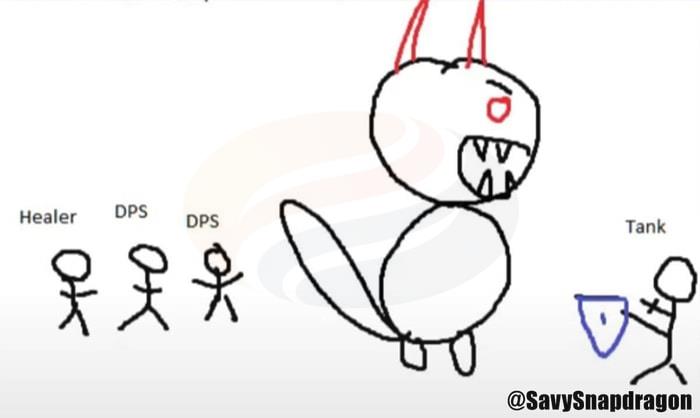
A general positioning recommendation for each role in group content of ESO
Positioning strategy forms the foundation of successful group execution. In standard formations, Tanks position themselves to taunt and maintain boss control, while DPS align behind the boss to avoid frontal attacks and cleaves. Healers maintain position behind DPS formations while remaining sufficiently close to Tanks to ensure consistent healing application. This arrangement facilitates optimal buff distribution from support roles to damage dealers while directing boss attention away from vulnerable party members. However, encounter-specific mechanics may demand alternative positioning arrangements, making this formation a reliable default when unfamiliar with specific fight requirements.
Proper group engagement etiquette mandates allowing Tanks to initiate all combat encounters. This unwritten rule ensures controlled enemy pulls and enhances overall party safety. When non-Tanks prematurely engage, boss artificial intelligence may randomly target party members lacking taunt application.
Multiple enemy scenarios particularly benefit from Tank-initiated engagement, enabling clear threat assessment and prioritization of dangerous targets before combat chaos ensues. This approach even permits Tanks to efficiently group and control multiple adversaries through snaring techniques. Adhering to these protocols significantly improves survival probabilities during group encounters. Consequently, demonstrate Tank appreciation by permitting them to establish engagement tempo.
ESO’s Dungeons and Trials environments contain numerous Treasure Chests with valuable contents. Unlike Overland chest mechanics, group content chests provide individualized loot instances for every participant, eliminating competition for rewards. These containers potentially house gear sets specific to their originating content location.
Standard community protocol involves announcing chest discoveries through group chat by typing “chest” and maintaining position until teammates acknowledge the find. While not every member will retrieve each chest, monitoring your map for returning players indicates when to maintain position near the container. Some players even attack chests repeatedly to visually highlight their location for distant party members.
Every dungeon features an associated questline accessible at the instance entrance. Completion rewards include a valuable Skill Point alongside gear pieces. When participating in pickup groups (PUGs) while desiring immersive narrative experiences, consider deferring quest acceptance. This prevents feeling rushed through storyline elements by teammates focused exclusively on rapid completion.
If narrative immersion concerns you less than Skill Point acquisition, immediately accept the quest and notify your group by typing “doing quest” in chat. Specific dungeons contain additional boss requirements for quest completion, making advance notification considerate toward your adventuring companions.
Within The Elder Scrolls Online, you might encounter players advertising “baby random normals” or “easy random normals” opportunities. These terms reference characters below level 45, commonly called “baby characters” in community parlance. Veteran players frequently extend these invitations through Guild or Zone channels to facilitate simpler dungeon experiences.
This practice stems from ESO’s dungeon queue mechanics. Groups containing sub-level-45 players cannot receive DLC dungeon assignments, as the matching system only selects from content accessible to all participants. Generally, players regard base-game dungeons as less challenging than their DLC counterparts. Consequently, novice players reaching level 10 shouldn’t hesitate joining group content, as experienced players often willingly assist with accessible random normal dungeons, regardless of “baby character” status.
Participating in ESO group content necessitates all players utilizing buff food consumables. This optimization aspect proves equally crucial as proper gear selection and represents a fundamental build component.
Buff food encompasses consumable items appearing as nourishment or beverages. These provisions deliver substantial enhancements to your primary resource pools including Health, Stamina, and Magicka maximums. Additionally, they improve regeneration rates for these essential combat resources.
No single buff food option maximizes every attribute simultaneously. Consequently, you must prioritize which aspects align with your build requirements. When determining optimal selections, consult established builds for your chosen class and role to identify content creator recommendations.
ESO contains hundreds of culinary recipes, creating selection overwhelm for unfamiliar players. When uncertain, selecting provisions that increase maximum Health, boost primary resource pools, and enhance resource regeneration consistently represents a reliable choice.
Group content participation in ESO should incorporate strategic potion usage. While potions deliver immediate resource restoration bursts, they primarily function as regeneration aids, preventing resource depletion before critical moments. Therefore, approach them as preventative measures rather than reactive solutions.
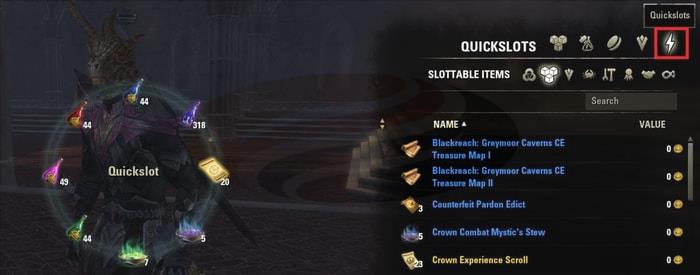
Equipping items to the Quickslots
Combat potion utilization requires proper Quickslot configuration:
1. Activate [I] to open your inventory interface.
2. Select the lightning bolt symbol in the upper-right corner to access Quickslot management.
3. Choose desired potions and position them in preferred Quickslot locations.
The triple-box icon indicates the tab containing slottable items inventory.
Quickslot potion activation procedure:
1. Maintain [Q] key pressure to reveal your Quickslot selection menu.
2. Hover over your chosen option and release the [Q] key
3. Subsequent quick [Q] key presses will consume your selected potion.
Potion type selection may seem intimidating given available options. However, the complimentary Crown Tri-Restoration Potion received through login rewards provides an excellent starting point. Avoid crafting concerns until pursuing advanced content, focusing initially on maintaining inventory and Quickslot habits.
Several passive abilities extend food and potion effectiveness durations:
• Gourmand (Provisioning skill line) prolongs consumed food duration by up to 20 minutes.
• Connoisseur (Provisioning skill line) extends drink consumable duration by maximum 20 minutes.
• Rationer (Craft CP tree) extends stat-boosting food and drink duration by up to 30 minutes.
• Medicinal Use (Alchemy skill line) increases active potion effects by 30% duration.
Buffs and debuffs constitute temporary character effects generated by abilities, equipment sets, or consumables. Buffs affect yourself or allies, while debuffs impair enemy capabilities. Crucially, identically named buffs or debuffs cannot stack effects. However, Major and Minor variants of identical buff or debuff types will combine effectively. Mastering this foundational concept enables superior group optimization. Consider these illustrative examples:
Example 1: During Trial encounters, if one healer utilizes Spell Power Cure while another employs Vestment of Olorime, both apply the Major Courage buff, rendering one set ineffective due to non-stacking mechanics.
Example 2: When Healers wear Spell Powered equipment alongside Tanks using Claw of Yolnahkriin, the party benefits from both Major and Minor Courage effects since they stack appropriately.
Buff stacking achieves maximum effectiveness through coordinated group planning. Multiple buff sources can synergistically advance identical objectives. Consider this theoretical illustration:
Spell Power Cure: + 430 Weapon and Spell Damage
Claw of Yolnahkriin: + 215 Weapon and Spell Damage
Powerful Assault: + 289 Weapon and Spell Damage
Pearlescent Ward: + 170 Weapon and Spell Damage
Spaulder of Ruin: + 260 Weapon and Spell Damage
Total Weapon and Spell Damage: 1364
This example demonstrates theoretical potential rather than precise in-game representation, illustrating how diverse sources can combine to amplify Weapon and Spell damage objectives.
Action Checklist
- Configure your role correctly in Group Finder before queueing for content
- Establish proper positioning with Tank facing boss, DPS behind, Healers in rear position
- Utilize appropriate buff food and potions based on your role requirements
- Follow resurrection protocols with DPS prioritizing revives
- Announce chest discoveries in group chat and maintain position until acknowledged
- Coordinate buff stacking with teammates to avoid redundant effects
No reproduction without permission:OnLineGames Guides » A Quick Guide to Playing Group Content in ESO Master ESO group content with essential etiquette, role mechanics, and optimization strategies for success