
TL;DR
- Level cap increased to 60 with 10 additional skill points and shared Paragon levels
- New eight-tier difficulty system with progressive attribute penalties in Torment modes
- Runeword system introduces Ritual and Sanctuary runes with Sacrifice mechanics
- Paragon system overhauled with new boards and glyph progression tied to Pit completion
- All classes receive new active skills and five passive enhancements
Diablo IV is launching its highly anticipated 2.0 Public Test Realm (PTR) from September 5 through September 12, giving players exclusive early access to transformative game updates. The Vessel of Hatred expansion introduces foundational changes that will reshape character progression and endgame systems. This testing period represents a crucial opportunity to experience and provide feedback on these major overhauls before they reach the live servers.
Leveling Adjustments
- The maximum character level has been elevated to 60, providing players with 10 additional skill points for enhanced build customization.
- Once you reach level 60, continued progression will award Paragon levels that unlock access to the powerful Paragon Board system.
- Paragon progression is now account-wide, meaning all your characters benefit from the same Paragon level progression.
Attribute Adjustments
Blizzard has streamlined core attribute calculations for Vitality, Armor, and primary stats to create more intuitive character building. These adjustments maintain current power levels while making stat values more transparent and easier to understand for optimization. The PTR will reveal how effectively these changes improve the player experience without compromising character effectiveness.
New Difficulty System
The game’s difficulty structure has been completely redesigned into eight distinct tiers: Normal, Hard, Expert, Penitent, and four levels of Torment difficulty. This expanded progression system offers more granular challenge options for players at different stages of their journey.
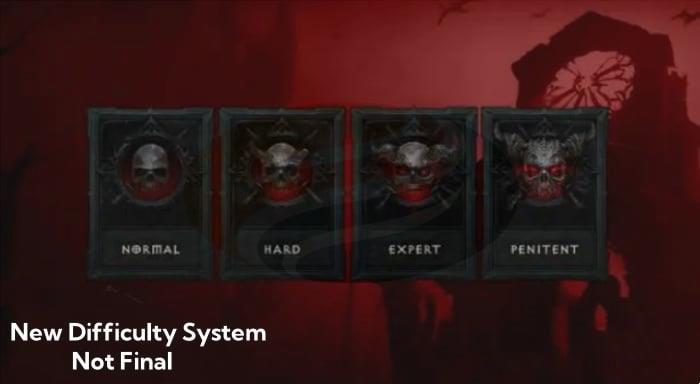
Normal and Hard difficulties are available immediately, while Expert requires completing the game’s prologue section. Penitent difficulty automatically unlocks once you reach level 50, providing a smooth transition to endgame content. Torment difficulty connects directly to Nightmare Dungeon tiers and features four escalating challenge levels: Torment I through IV. Upon hitting level 60, players gain access to Pit tiers 1-20, which serve as the new Nightmare Dungeon equivalent content.
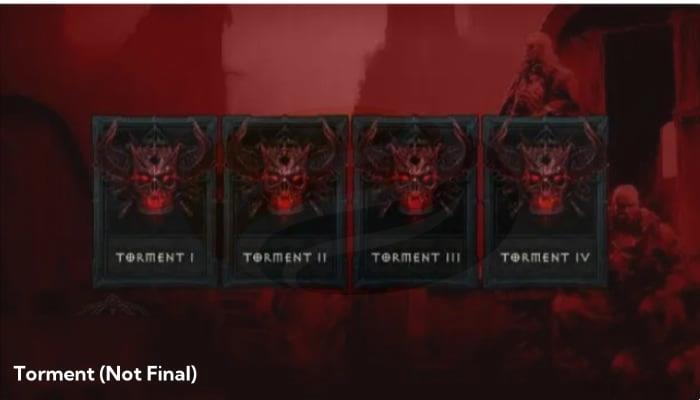
Torment Difficulty Unlock Requirements:
- Complete Pit tier 20 to unlock Torment Difficulty I.
- Complete Pit Tier 35 to unlock Torment Difficulty II.
- Complete Pit Tier 50 to unlock Torment Difficulty III.
- Complete Pit Tier 65 to unlock Torment Difficulty IV.
Each Torment level imposes progressively severe attribute reductions that significantly impact your survival capabilities:
- Torment I: Reduce Armor by 250, all resistances reduced by 25%.
- Torment II: Reduce Armor by 500, all resistances reduced by 50%.
- Torment III: Reduce Armor by 750, all resistances reduced by 75%.
- Torment IV: Reduce Armor by 1000, all resistances reduced by 100%.
Runeword System
The groundbreaking Runeword system becomes available on the PTR starting September 7, though in the live game this feature will require purchasing the “Vessel of Hatred” expansion. Runewords function similarly to socketable gems but offer more complex and synergistic effects through strategic combinations.
Runes in Diablo IV are categorized into two distinct types: Ritual and Sanctuary runes, each serving different mechanical purposes within the system.
- Ritual Runes activate their effects through specific gameplay actions like using basic skills, ultimate abilities, consuming potions, or taking damage. Successfully performing these actions grants Sacrifice resources.
- Sanctuary Runes consume the Sacrifices generated by Ritual Runes to trigger powerful secondary effects.
Practical Examples:
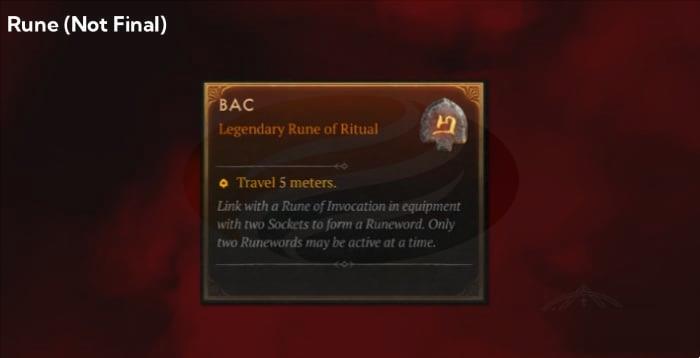
BAC represents a Ritual Rune that triggers after moving 5 meters, providing 50 Sacrifices.
JAH functions as a Sanctuary Rune that expends 500 Sacrifices to transform your next Dodge into a Teleport ability.
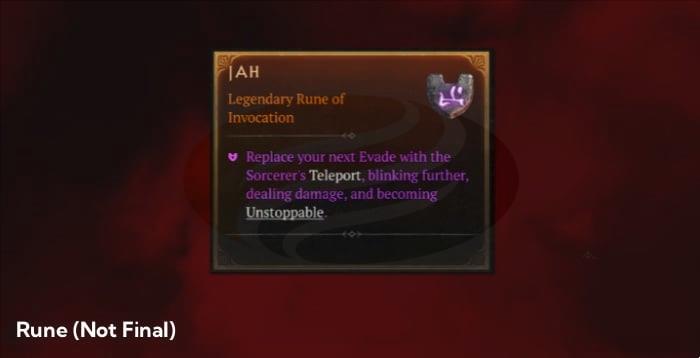
When combining these two runes, they generate a synergistic effect: every 50 meters traveled activates the Mage’s Teleport Enchantment, converting your next Dodge into Teleport (available to all character classes).
Through the Runeword system, players can access cross-class abilities or temporarily enhance movement speed and skill effectiveness. The current system includes 17 distinct Ritual Runes and 28 Sanctuary Runes, creating nearly limitless combination possibilities for advanced build crafting.
Rune Characteristics:
- Can be traded between players
- Can be stacked in inventory
- Each rune type can only be equipped once per character
- Maximum of two complete Runeword sets (four individual runes) can be equipped simultaneously
- Available in Magic, Rare, and Legendary quality tiers, with higher rarities providing significantly enhanced effects
- Three identical runes can be combined to create any new rune type, with probability for generating superior quality runes
- Runes serve as crafting components for powerful items including Holy Unique equipment
Monster Level Adjustments
Monster level indicators have been removed from the interface, with enemy strength now scaling exclusively based on selected difficulty tier. This fundamental change allows players to freely select their preferred challenge level without worrying about out-leveling content. The new system ensures monster difficulty remains consistent regardless of player level progression.
Paragon System Update
Glyphs
Glyph advancement no longer depends on experience point accumulation; progression is now directly tied to successful completion of Pit Tiers. The maximum Glyph level cap has been substantially increased from 21 to 100, providing dramatically extended progression depth. Rare-quality Glyphs can be upgraded to Legendary status at level 45 using Gem Shards, acquiring the following significant enhancements:
-
- The Glyph’s effective radius expands from 4 to 5 nodes on the Paragon Board.
- The Glyph gains additional powerful attributes beyond its base effects.
Players can rapidly unlock extended range amplification for their glyphs by completing three consecutive Tier 30 Nightmare Dungeon runs without dying, which immediately boosts glyphs to level 19:
First Completion of Pit
-
-
- Attempt 1: Glyph level increases from 1 to 3
- Attempt 2: Glyph level increases from 3 to 5
- Attempt 3: Glyph level increases from 5 to 7
- Extra Attempt 4: Glyph level increases from 7 to 9
-
Second Completion of Pit
-
-
- Attempt 1: Glyph level increases from 9 to 11
- Attempt 2: Glyph level increases from 11 to 12
- Attempt 3: Glyph level increases from 12 to 13
- Extra Attempt 4: Glyph level increases from 13 to 14
-
Third Completion of Pit
-
-
- Attempt 1: Glyph level increases from 14 to 15 (range increases)
- Attempt 2: Glyph level increases from 15 to 16
- Attempt 3: Glyph level increases from 16 to 17
- Extra Attempt 4: Glyph level increases from 17 to 18
-
Paragon Board
-
- Every character class receives one additional Paragon Board for enhanced build diversity.
- The total Paragon Points available through level progression has increased from 200 to 300, providing substantially more customization options.
- Each character can now activate up to 5 distinct Paragon Boards simultaneously.
Item Rework
Sacred items have been completely removed from the game’s loot system. Items are now categorized exclusively as either Ancestral or non-Ancestral quality tiers, simplifying the item progression path while maintaining meaningful power distinctions.
Ancestral Items
-
- Ancestral items begin appearing in loot drops starting from Torment 1 difficulty.
- Ancestral items consistently drop with maximum item power of 800.
- Only Ancestral-quality items can roll powerful Primal affixes.
- Every Ancestral item guarantees at least one Primal affix.
General Items
-
- Non-Ancestral items have a maximum achievable item power of 750.
- Upon reaching level 60, all legendary items that drop will have an item power of 750.
- Items with power level 750 can now be reforged up to 4 times for enhanced customization.
- Primal affixes cannot appear on non-Ancestral items.
New Class Skills and Passive Skills
Each character class receives one new active skill:
- Barbarian: Power Throw – Hurl your weapon to damage enemies while temporarily increasing attack speed.
- Druid: Rock Burst – Detonate surrounding stone formations for massive area-of-effect damage.
- Necromancer: Soul Rift – Absorb soul energy to generate protective barriers and amplify damage output.
- Rogue: Blade Dance – Release a barrage of spinning blades that enhance movement speed and dodge probability.
- Sorcerer: Elemental Familiar – Summon elemental companions that boost the effectiveness of your magical skills.
Each class gains 5 new passive skill enhancements:
- Barbarian: Enhances basic skill damage output and improves damage resistance capabilities.
- Druid: Increases damage potential and movement speed while in human form.
- Necromancer: Strengthens barrier absorption capacity and increases damage dealt to elite monster types.
- Rogue: Boosts critical strike chance, enhances damage following successful dodges, and improves overall damage reduction.
- Sorcerer: Reduces skill cooldown times, increases barrier effectiveness, and amplifies elemental damage types.
PTR Features
- Instant character leveling to either 50 or 60 for immediate testing access.
- Complete map exploration including all story quest progression, stronghold locations, waypoint access, and fog of war clearance.
- Unlock all passive skill trees for comprehensive build experimentation.
- Access all Torment difficulty tiers without meeting standard unlock requirements.
- Fully upgraded healing potion capacity and effectiveness.
- Maximum progression for all Glyph levels and Paragon point allocation.
- Generate legendary items for testing specific build combinations.
- Acquire all unique items, rune types, and essential crafting materials.
- Obtain complete collection of alchemical manuals for crafting system testing.
The Diablo IV 2.0 Public Test Realm operates from September 5 through September 12. This represents a limited-time opportunity to experience these transformative system changes and provide valuable feedback to the development team before the updates reach the live game environment.
Action Checklist
- Create test characters at both level 50 and 60 to evaluate different progression stages
- Experiment with Runeword combinations using different Ritual and Sanctuary rune pairings
- Test all eight difficulty tiers to understand attribute penalty scaling
- Complete Pit tiers 20, 35, 50, and 65 to unlock Torment difficulties
- Submit detailed feedback through official channels about system balance and gameplay experience
No reproduction without permission:OnLineGames Guides » Diablo 4 Patch 2.0: Everything is Changed Diablo IV 2.0 PTR brings level cap increase, new difficulty system, and revolutionary Runeword mechanics