
TL;DR
- Planetary production requires no ships and generates passive ISK income while you’re offline
- Security level dramatically impacts yield rates – nullsec systems offer 6x higher production
- Planetology skill unlocks additional arrays, planets, and cargo capacity
- Regular login every 24 hours is required to maintain maximum production efficiency
- Collection involves launching containers into space with PvP theft risks in low-security areas
EVE Echoes ISK serves as the primary economic currency within EVE Echoes, essential for ship purchases, equipment upgrades, and market trading. Every pilot seeks to increase their ISK reserves, making planetary production an essential passive income stream. This comprehensive guide explores Planetary Production mechanics to establish your optimal foundation in New Eden’s industrial ecosystem.
This guide incorporates insights from Captain Benzie‘s expert planetary production tutorial, adapted into comprehensive written format for optimal reference and implementation.
Planetary Production represents a unique resource extraction method distinct from asteroid mining. The system operates without ship requirements, making it accessible to combat-focused pilots seeking supplementary income streams. Unlike active mining operations that require continuous gameplay, planetary production continues generating materials while you’re offline, creating true passive income potential.
Access the planetary production interface through your main menu navigation. The planetary overview screen displays celestial bodies within your current solar system with detailed geological information. Each planet features unique resource compositions and yield potentials that directly impact your profitability calculations.
Planet types directly determine available resources – lava planets like N7-BIY 1 contain glossy compounds, heavy metals, noble metals, or poly aramids. Resource abundance varies significantly: glossy compounds offer medium yields, heavy metals medium, noble metals poor, and poly aramids rich concentrations. System scanning reveals diverse planetary types including barren worlds, temperate planets, and lava formations, each with distinct mineral distribution patterns.
Temperate planets such as N7-BIY6 feature opulent compounds and condensates at perfect quality ratings. Higher quality resources generate increased yields per extraction cycle and accelerate mining array fill rates. Common materials include fiber composites, reactive metals, coolant, and lustering alloy. Lustering alloy serves as a fundamental manufacturing component with consistent market demand, making it ideal for beginners with limited array capacity.
Deploy your initial development array by selecting your target planet. Your planetary skill level determines maximum concurrent mining operations – beginners can establish one array, while advanced training unlocks multiple planetary operations simultaneously.
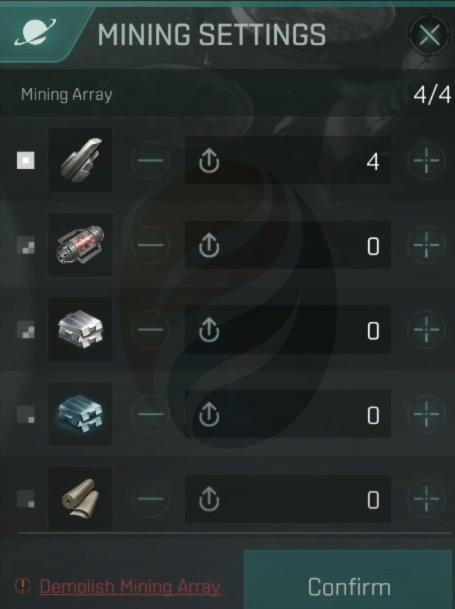
Array configuration utilizes plus/minus arrows to allocate extraction focus across available resources. Strategic allocation concentrates extraction on high-demand materials like lustering alloy rather than diversifying across multiple low-yield resources.
Planetology skill development fundamentally transforms your planetary production capabilities. The industrial skills section contains planet management specialization under planetology. Complete advanced tutorials to receive complimentary planetology skill chips that refund previously invested skill points.
Skill progression delivers compounding benefits: Level 1 accelerates launch speed by 10% and expands cargo capacity by 20%. Level 2 unlocks an additional mining array, increasing from two to three concurrent extraction points. Level 3 provides +2 arrays (total four), 30% faster launches, and doubled cargo hold dimensions.
Advanced tiers deliver exponential improvements – Level 4 enables mining on two separate planets with five arrays each, plus 40% launch acceleration and 150% cargo capacity. Level 5 mastery offers 50% speed enhancement, six total mining arrays across two planets, and triple standard cargo hold volume.
Advanced Planetology requires Omega clone status and provides superior tier benefits for dedicated industrial specialists.
Common beginner mistake: Underestimating skill point investment returns. Planetology represents the sole required skill for planetary production, making it exceptionally accessible compared to other industrial professions requiring multiple skill trees.
Solar system security status dramatically influences planetary production efficiency. Higher security systems (0.8+) generate significantly slower yields with reduced output volumes. Nullsec operations in -0.6 systems like N7-BIY produce approximately 6x higher output compared to highsec equivalents.
Comparative analysis demonstrates stark contrasts: nullsec arrays generate lustering alloy 6 within equivalent timeframes where highsec would produce only single units.
Production timing requires strategic management – arrays operate on 2.5-hour cycles, requiring daily login sessions to maintain 24-hour production windows. Failure to refresh arrays results in production caps and missed income opportunities.
Optimal collection strategy: Accumulate multiple production cycles before launching containers to minimize travel time and exposure risks.
System scouting proves essential for resource targeting. If manufacturing blueprints require specific materials like base metals, explore neighboring systems to identify optimal planetary sources matching your production requirements.
Container retrieval initiates through the launch function within planetary production interface. Launch duration varies from seconds to minutes based on cargo volume. Critical security protocol: Immediately set destination and expedite travel to collection points, especially in nullsec territories where unattended containers become PvP looting targets.
Undocking triggers automated navigation to jettison coordinates. Container availability appears after brief processing period, enabling immediate looting operations. Multiple containers from different players may coexist in the same space, creating potential ethical dilemmas regarding resource acquisition.
Risk mitigation strategy: Coordinate collection timing with corp members to provide security coverage during vulnerable retrieval phases.
Planetary production serves as the primary gateway to manufacturing careers due to its time-gated resource generation. Unlike active mining, you cannot force production acceleration – strategic patience and regular maintenance deliver optimal ISK generation.
Market integration: Collected resources maintain consistent demand on regional markets, providing reliable income streams. Even combat-focused characters benefit from establishing basic planetary production operations as supplementary income sources.
MmoGah, as a trusted marketplace to buy eve echoes isk, continues providing updated EVE Echoes strategies through our dedicated news channel for ongoing industrial optimization.
Action Checklist
- Complete advanced tutorials for free planetology skill chip
- Scout nearby systems for optimal resource planets matching your blueprint requirements
- Deploy initial mining array on selected planet focusing on high-demand materials
- Configure array allocation to maximize lustering alloy or other perfect-rated resource extraction
- Establish daily login routine to refresh 24-hour production cycles
- Train planetology to level 2 within first week to unlock third mining array
- Schedule collection runs after accumulating multiple production cycles to optimize travel efficiency
No reproduction without permission:OnLineGames Guides » EVE Echoes ISK Farming Guide – Planetary Production Master planetary production in EVE Echoes to generate passive ISK income with zero ship requirements