
TL;DR
- Path of Exile’s complexity requires understanding three core attributes that define seven distinct character classes
- The passive skill tree contains over 1,300 nodes but follows logical patterns when understood systematically
- Loot filters are mandatory for efficient gameplay and prevent inventory management overwhelm
- Proper character planning from level 1 prevents costly respecs and wasted playtime
- Learning to identify valuable items and manage currency is crucial for progression
Grinding Gear Games released Path of Exile in 2013 as a free-to-play action RPG that revolutionized the genre with unprecedented customization depth. Unlike traditional RPGs that offer linear progression paths, PoE presents a sandbox of interconnected systems where every decision carries long-term consequences for your character’s development trajectory.
New players frequently underestimate the learning curve, which demands significant time investment to grasp fundamental mechanics. The game’s complexity stems from synergistic systems where character attributes, skill gems, passive tree choices, and equipment selections create exponential build possibilities.

Learn The Basics
Path of Exile distinguishes itself through nearly limitless character customization that accommodates countless playstyles. This freedom empowers experienced players to create highly specialized builds while presenting newcomers with analysis paralysis from the overwhelming options available.
The foundation of character building rests on three primary attributes: Intelligence, Strength, and Dexterity. These attributes determine your starting position on the passive skill tree and influence which skills and equipment your character can effectively utilize throughout their journey.
Intelligence:
Intelligence governs magical prowess and arcane knowledge, represented by the Witch class who specializes in spellcasting with scepters and wands. Intelligence-based armor provides energy shields that absorb damage and regenerate when avoiding combat, making them ideal for casters who maintain distance from enemies. The Witch’s ascendancy specializations include Occultist for chaos and curse focus, Necromancer for minion mastery, and Elementalist for pure elemental damage amplification.
Strength:
Strength enhances physical power and durability, embodied by the Marauder who wields maces for devastating melee impact. Fire element aligns with strength attributes, while strength armor grants substantial physical damage reduction. The Marauder’s ascendancy paths offer Berserker for pure damage, Chieftain for fire and totem synergy, and Juggernaut for unparalleled defensive capabilities.
Dexterity:
Dexterity enables combat agility and precision, personified by the Ranger who excels with bows and rapiers for rapid strikes. Dexterity armor facilitates quick evasion maneuvers, making these characters exceptionally difficult for enemies to hit consistently. Ranger ascendancy options include Pathfinder for flask optimization, Deadeye for projectile specialization, and Raider for movement and attack speed focus.
After mastering the pure attribute classes, hybrid characters combine multiple attributes for specialized roles. These four hybrid classes occupy strategic positions between the primary attribute clusters on the passive tree.
Shadow:
The Shadow merges dexterity and intelligence, employing claws and daggers while utilizing spells, traps, and mines for versatile combat approaches. His ascendancy specializations include Trickster for hybrid defense, Saboteur for trap and mine supremacy, and Assassin for critical strike specialization.
Templar:
The Templar balances intelligence and strength, channeling both attributes through scepters and staves to deliver devastating elemental melee attacks alongside spellcasting capabilities. Templar ascendancy classes include Hierophant for totem and mana focus, Guardian for support and defense, and Inquisitor for elemental penetration and critical strikes.
Duelist:
The Duelist commands strength and dexterity, fighting with axes and swords while leveraging both armor types for balanced defense and evasion. Duelist ascendancy paths include Gladiator for block and bleed, Champion for tankiness and aura effectiveness, and Slayer for leech and area clearing prowess.
Scion:
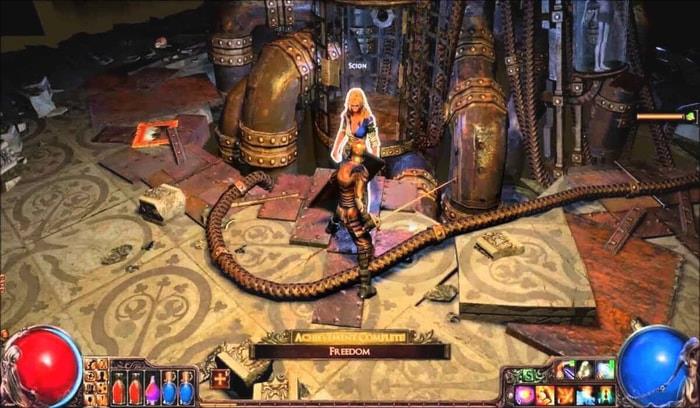
The Scion demonstrates proficiency across all three attributes, offering unparalleled flexibility in build creation. Positioned at the exact center of the passive skill tree, the Scion becomes available after completing a specific storyline quest. Her exclusive ascendancy class, Ascendant, provides unique access to modified versions of other classes’ ascendancy perks.
The passive skill tree represents Path of Exile’s most intimidating yet rewarding system, featuring over 1,300 nodes that collectively define your character’s capabilities. First-time viewers often experience information overload when confronted with this sprawling network of interconnected choices that appears impossibly complex at initial glance.
Despite its daunting appearance, the passive tree follows logical organizational principles. Seven distinct starting positions correspond to each character class, with the tree radiating outward into specialized clusters that enhance specific playstyles and mechanics.
● Damage Type: Nodes that amplify specific damage sources like elemental, physical, or chaos
● Defense Type: Clusters providing life, energy shield, armor, evasion, or block chance
● Cluster Jewels: Socketable jewels that create entirely new passive clusters with specialized effects
Strategic pathing through the tree involves balancing offensive power with defensive layers while traveling toward keystone passives that fundamentally alter gameplay mechanics.
● Scion
● Witch
● Shadow
● Ranger
● Duelist
● Marauder
● Templar
Beyond primary pathing, the tree contains jewel sockets for customizing your build further with unique effects. Cluster jewels introduced in later expansions allow players to create entirely custom passive clusters that can dramatically alter a character’s power curve and specialization focus.
Path of Exile’s loot system generates enormous quantities of items, particularly during endgame mapping and league content. Without proper filtering, players waste valuable playtime manually inspecting hundreds of irrelevant drops searching for worthwhile equipment or currency.
Loot filters solve this problem by automatically highlighting valuable items while hiding worthless clutter. Customizable filters can be tailored to your current build requirements and progression stage, dramatically improving gameplay efficiency.
Download A Loot Filter
As you progress through Path of Exile’s content, loot accumulation accelerates exponentially. Implementing a quality loot filter becomes essential rather than optional, as the visual noise from unfiltered drops makes identifying actual upgrades nearly impossible during hectic combat situations.
Effective filters not only hide worthless items but use sound cues and colored text to prioritize different rarity tiers and currency types based on their current value to your character.
Manage your inventory
Inventory management represents a critical skill that separates efficient players from those constantly struggling with space limitations. The game’s strict inventory constraints force players to make constant value judgments about what to keep versus what to vendor or discard.
Item rarity follows a color-coded system: white indicates normal items, blue signifies magic items with 1-2 modifiers, and yellow denotes rare items with 3-6 random affixes that determine their power and usability.
Understanding Path of Exile’s economy enables you to convert unwanted items into currency that can purchase upgrades. While third-party marketplaces exist, the official trade site provides secure transactions between players using in-game currency as the primary medium of exchange.
Conclusion
Despite Path of Exile’s generous loot distribution, finding specific upgrades for your build remains statistically unlikely through random drops alone. This economic reality makes understanding trading mechanics essential for character progression beyond the campaign.
New players should embrace the learning process rather than becoming discouraged by initial complexity. Regular reference to foundational guides combined with hands-on experimentation creates the most effective learning pathway through Wraeclast’s complexities.
Action Checklist
- Research and install a recommended loot filter like FilterBlade or Neversink
- Follow a proven beginner build guide for your first character
- Plan your passive tree path before allocating points
- Learn vendor recipes for converting items into useful currency
- Establish organized stash tab system for different item categories
No reproduction without permission:OnLineGames Guides » Tips to Improve in Path of Exile Master Path of Exile with essential character guides, skill tree navigation, and inventory management strategies