
TL;DR
- Choose Softcore for learning, Hardcore for ultimate challenge with permanent death consequences
- Select classes based on preferred playstyle: Sorceress for spells, Warrior for melee, Ranger for ranged combat
- Prioritize life and resistance mods on armor, spell/attack damage on weapons for early progression
- Use search function extensively in passive tree and experiment with gem combinations freely
- Leverage gold-based respec system to correct mistakes without character restart
Path of Exile 2 presents an expansive ARPG experience with nearly limitless character customization possibilities across numerous interconnected systems. This comprehensive guide concentrates on the foundational knowledge required during your initial gameplay sessions, systematically walking through the complete character creation process from class selection to endgame preparation.
Softcore vs Hardcore Analysis
● Softcore: Experience Penalty on Death – You lose a portion of accumulated experience upon dying but can continue playing immediately
● Hardcore: Permanent Character Death – Your character is permanently deleted if you die, requiring complete restart
Risk Assessment Framework
New players should strongly consider beginning with Softcore mode to familiarize themselves with game mechanics without severe consequences for mistakes. The experience penalty provides enough incentive to play carefully while allowing learning through experimentation. Hardcore demands perfect execution and extensive game knowledge, making it ideal for veteran players seeking maximum challenge.
Class Specializations
● Sorceress: Stormweaver/Chronomancer – Elemental damage specialists with time manipulation capabilities
● Warrior: Titan/Warbringer – Melee powerhouses with brute force or aggressive combat styles
● Ranger: Deadeye/Pathfinder – Precision attackers with mobility or survival specialization
● Witch: Blood Mage/Infernalist – Life-based casters or fire/chaos damage experts
● Mercenary: Witchhunter/Gemling Leginonneire – Hybrid combatants with anti-magic or gem-enhanced abilities
● Monk: Invoker/Acolyte of Chayula – Martial artists with invocation magic or chaos alignment
Ascendancy Synergy Planning
Each ascendancy represents a specialized evolution of your base class, dramatically altering gameplay mechanics and power orientation. Stormweaver focuses on lightning and cold damage amplification, while Chronomancer manipulates cooldowns and attack sequences. Your ascendancy choice should align with both preferred playstyle and intended skill gem combinations for optimal performance.
Item Acquisition Methods
● Picked up off the Ground – Immediate access but random quality
● Bought from a Vendor (Gold) – Reliable source for specific base types
● Gambled (Gold) – High-risk method for potentially powerful items
Currency Management
● Drops from Monsters – Primary currency source through normal gameplay
● Disenchanting Items – Strategic dismantling of unwanted gear for crafting materials
Blue Items = Blue Currency – Magic items yield basic crafting components
Yellow Items = Yellow Currency – Rare items provide enhanced crafting resources
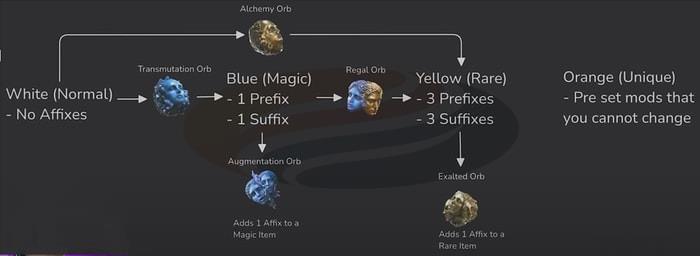
(Picture Scouring: the YouTuber Big Ducks)
Mod Priority Framework
Armour Pieces and Jewelry
● Life (Prefix) Resistances (Suffix) – Survival priority for all builds
Caster Weapons
● % Spell Damage (Prefix) – Multiplicative damage scaling
● Added Spell Damage (Prefix) – Flat damage addition
● Gem Levels (Prefix) – Significant skill power increases
● Cast Speed (Suffix) – Action efficiency improvement
● Spell Crit (Suffix) – Critical strike specialization
Attack Weapons
● % Physical Damage (Prefix) – Base damage multiplier
● Added Physical Damage (Prefix) – Direct damage augmentation
● Added Elemental Damage (Prefix) – Elemental conversion support
● Attack Speed (Suffix) – Actions per second increase
● Crit Chance or Damage (Suffix) – Critical hit optimization
Skill Gems
(Primary active abilities for combat execution)
● Obtained through Uncut Skill Gems – Requires gem activation before use
● Focus on Combos – Strategic ability sequencing for maximum effectiveness
● Don’t be afraid to swap if something isn’t working out – Flexibility is key to finding optimal setups
● Make sure to use Uncut Skill Gems to level the skills you end up using – Progressive power development
Support Gems
(Modification gems that socket into skill gems to alter their behavior)
● Obtained through Uncut Support Gems – Separate acquisition system from skill gems
● 1 of each per character – Limited availability encourages strategic selection
● Tons of various effects. Don’t be afraid to experiment and combine – Extensive customization possibilities through support combinations
Spirit Gems
(Persistent effect gems including Auras, Buffs, or Minion abilities)
● Obtained through Uncut Spirit Gems – Specialized gem category for sustained effects
● Limited by the “Spirit” resource – Resource management system for sustained abilities
● Without investing in Spirit, you will only be able to have 1 or 2 auras/buffs – Strategic investment decisions required
The passive skill tree represents one of Path of Exile 2’s most intimidating yet rewarding systems, presenting thousands of interconnected nodes for character customization. While the initial appearance suggests overwhelming complexity, strategic navigation reveals structured pathways tailored to specific playstyles and build archetypes.
Navigation Strategies
Utilize the search function extensively when exploring the passive tree interface. For two-handed weapon builds, searching “two-handed” reveals clusters specializing in attack speed enhancements and damage amplification. Crossbow specialists should search for “crossbow” to locate nodes providing ammunition efficiency and critical strike enhancements. Since crossbows utilize projectile mechanics, additional searches for “projectile” uncover complementary damage and utility options.

(Picture Scouring: the YouTuber Big Ducks)
Node Type Optimization
Attributes
● Choose between Str/Dex/Int as your build requires – Attribute alignment with primary skills
● Can change later for gold – Flexible respec system allows correction
Small Passives
● Minor nodes with small effects will lead you towards notables with stronger effects – Pathway construction methodology
● Minor, but still very important – Cumulative effect significance
Notable Passives
● Larger nodes at the end of small paths provide larger and more potent effects – Major power spike locations
● These should determine your overall path – Strategic routing based on key notables
Keystones
● Extremely powerful nodes with huge upsides and typically huge downsides – High-risk, high-reward decisions
● Typically character-defining, so be careful with which ones you take – Build identity formation points
Jewel Sockets
● Can insert Jewels that you can craft like other items – Additional customization layer
● Sometimes, they are not craftable and have powerful effects – Unique item integration points
Respec Planning
During the initial gameplay period before comprehensive build guides become available and mathematical optimization is established, select passive tree points that logically support your character’s development direction. The gold-based respec system provides substantial flexibility for correcting mistakes in the early stages. If you discover your current build isn’t performing optimally, dedicate an hour or two to gold farming, then reallocate your passive points. This process proved consistently manageable during extensive playtesting sessions.
Weapon Swap Systems
Weapon Set Passives will automatically swap when you change weapons – Dynamic specialization adjustment system
Jewel Socket Strategies
Jewel sockets represent significant power customization opportunities beyond the standard passive tree. These sockets accept crafted jewels that function similarly to other equipment items, providing targeted stat boosts or unique effects. Some jewel sockets contain pre-determined powerful effects that cannot be modified, offering build-defining capabilities when strategically incorporated into your passive tree pathing.
Strategic Build Development
Constructing your initial Path of Exile 2 character build may appear overwhelming given the extensive passive skill selection available. Through methodical application of the guidance provided by content creators like Big Ducks combined with patient experimentation, you’ll develop a character build that aligns with your preferred gameplay approach while maximizing effectiveness within Wraeclast’s dangerous environments.
Action Checklist
- Select Softcore mode for learning flexibility or Hardcore for ultimate challenge
- Choose class and ascendancy based on preferred combat style and skill preferences
- Prioritize life and resistance mods on armor pieces for survival
- Experiment with skill-support gem combinations using gold respec as safety net
- Use passive tree search function to locate relevant nodes for your build archetype
- Farm gold for respec currency if initial build decisions require adjustment
No reproduction without permission:OnLineGames Guides » PoE 2 Build Guide: How to Make Your First Build Master Path of Exile 2 character building with expert strategies for gearing, skills, and passive tree optimization